English
 Español

A ductless fume hood captures contaminated air, passes it through specialised filters and returns the filtered air to the laboratory. Because the air is recirculated rather than exhausted outdoors, selecting the correct filter is essential.
The appropriate filter depends on the chemicals, quantities, temperatures and processes used inside the hood. A filter should never be selected only by product name or general laboratory application.

Activated carbon filters remove many chemical vapours through adsorption. Contaminant molecules are retained within the filter media as air passes through it.
Different carbon formulations may be designed for organic vapours, acid gases, ammonia, formaldehyde or mixed chemical applications. However, one filter cannot safely capture every chemical.
Before purchasing, laboratories should prepare a complete list of the substances that will be used, including their concentration, quantity, frequency of use and operating temperature.
HEPA filters are designed to capture fine airborne particles, powders and aerosols. They do not replace activated carbon filters when the main hazard is a chemical gas or vapour.
Applications involving both particles and chemical vapours may require a combination of HEPA and activated-carbon filtration. The correct filter order and configuration should be confirmed by the equipment manufacturer.
A chemical assessment determines whether a ductless fume hood is suitable for the intended process. Important information includes:
Chemicals and mixtures being handled
Quantities used during each procedure
Frequency and duration of use
Chemical temperature and evaporation rate
Possibility of spills or unexpected reactions
Powders, particles or aerosols generated
Some highly volatile, highly toxic, heated or large-volume chemical processes may not be suitable for ductless filtration. In these situations, a ducted fume hood or another specialised containment system may be required.
Filters have a limited adsorption capacity and must be replaced before contaminants pass through the filter media. Replacement should be based on the chemical assessment, actual usage, monitoring results and the manufacturer’s recommendations—not only a fixed calendar interval.
Useful safety features may include airflow monitoring, differential-pressure sensors, TVOC monitoring and alarms that indicate airflow problems or filter saturation.
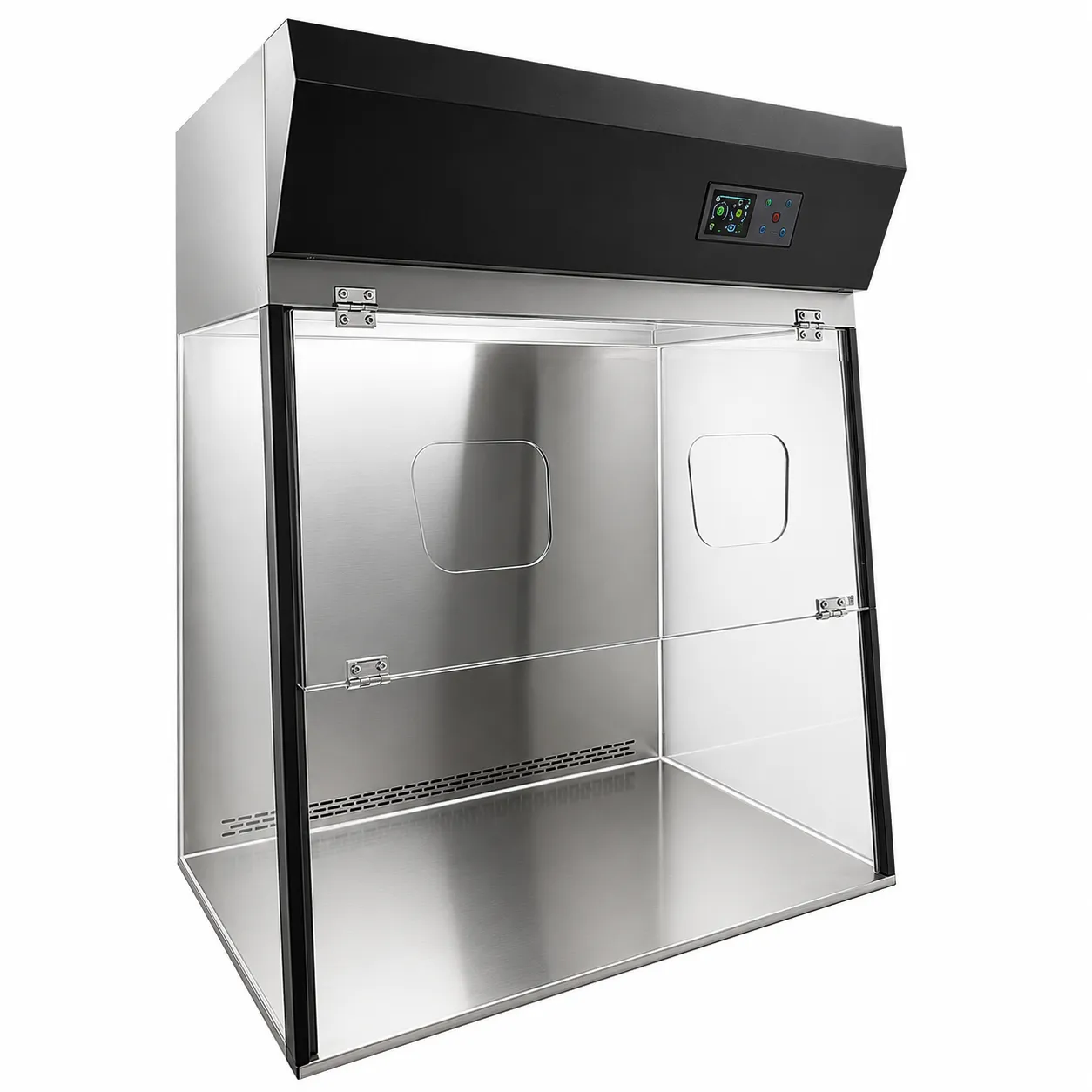
The Kenton HT Series ductless fume hood uses negative-pressure airflow and activated-carbon filtration to capture chemical vapours without requiring external ductwork. Optional HEPA filtration and intelligent monitoring functions are available for different laboratory requirements.
For filter selection, chemical compatibility assessment or OEM/ODM enquiries, contact Kenton at kenton@kentonchina.com.